Conversational AI in hospitality has reached a tipping point. Remaining undecided about it is a strategy…but a risky one. The stakes are high. Not taking action could mean missed opportunities to bring in more revenue, optimize your hotel’s service and help your staff. You don’t want to be the lone property buried in the dust of a rapidly evolving guest experience.
From answering guest questions instantly to automating bookings, upsells and service requests, conversational AI creates opportunities for guests and staff. This guide breaks down the most valuable use cases for conversational AI in hotels and best practices for successful implementation. You’ll learn where conversational AI delivers the biggest operational impact, how leading hotels are using it today and what to look for when evaluating hospitality-specific AI platforms.
Key highlights:
Conversational AI for hotels uses AI-powered voice, messaging and chat tools to automate guest communication and hotel workflows across the guest journey.
Hotels are using conversational AI to answer guest questions instantly, automate repetitive tasks and increase direct bookings and upsell revenue.
The best conversational AI platforms for hospitality integrate with solutions like Guest Management Systems (GMSs), Property Management Systems (PMSs) and Customer Relationship Management (CRM) platforms to deliver personalized, end-to-end guest experiences.
Canary Technologies delivers hospitality-specific conversational AI solutions that automate guest interactions while empowering hotel staff to focus on high-value guest service.
What Is Conversational AI in Hospitality?
Conversational AI is artificial intelligence that automates and personalizes guest communication across channels like messaging, voice and webchat. Hotels use conversational AI to answer guest questions instantly, manage bookings, automate service requests and deliver personalized recommendations throughout the guest journey.
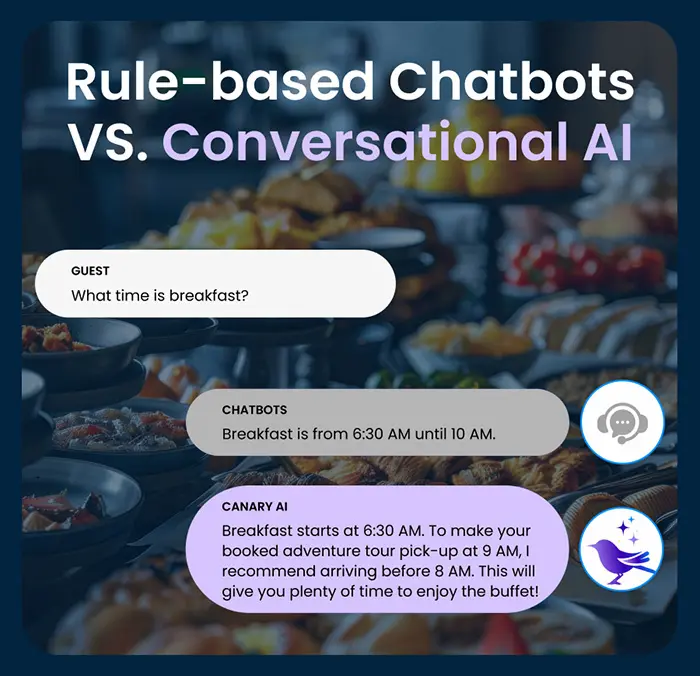
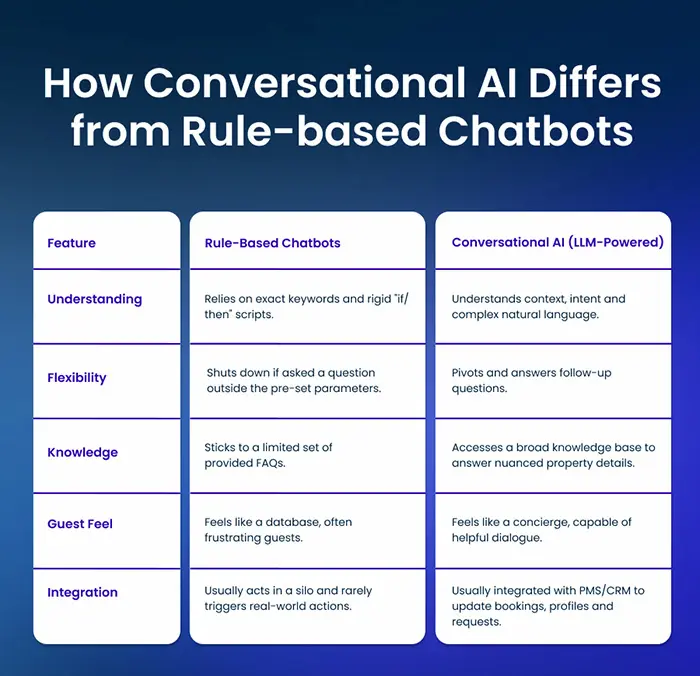
Unlike rule-based chatbots that rely on scripted responses and limited workflows, AI-driven conversational systems use machine learning to understand what guests want and respond naturally. And with relevant integrations, modern hospitality AI platforms can also complete tasks end-to-end, from updating reservations and triggering housekeeping requests to surfacing upsell offers automatically. According to Canary Technologies’ 2026 hospitality AI research report, 58% of hoteliers believe AI will have the biggest impact on guest communications, making it the leading AI use case for hotels today.
How Conversational AI Differs From Rule-Based Chatbots
Conversational AI for Hotels: Top Use Cases
First impressions used to happen by walking into a lobby or hopping on a phone call. These days, it happens when a traveler hits your hotel’s website.
But when conversational AI is part of that process, response times are quickened and guest satisfaction increases. Smart use of these tools streamlines operations, reduces staff workload and creates new revenue opportunities through automation and personalization at every point of the stay.
1. Pre-Booking and Reservation Automation
According to Boston Consulting Group, the guest journey for 37% of travelers starts with a single prompt. Major travel platforms and search engines have already integrated generative AI into the discovery phase, meaning guests arrive at your website in a "conversational" state of mind. Your site needs to continue that conversation…or you risk losing momentum (and their booking).
In practice, this means you should never miss an opportunity to engage a potential guest. Conversational AI can help: it delivers instant answers to guest inquiries, acts as a 24/7 customer service layer and completes reservations without staff assistance. Specifically developed hotel AI chatbots integrate directly with hotel systems to provide accurate availability, pricing and policy information, while reducing front desk workload.
Here’s how conversational AI can enhance your pre-arrival process:
Instantly answers nuanced booking and amenity questions that an external LLM might “hallucinate” or miss entirely (for example, “Is the pool heated in October?”)
Reduces missed calls and abandoned reservations
Provides 24/7 multilingual guest support
Automates booking confirmations and pre-arrival communication
Surfaces personalized room upgrades and add-ons before arrival
2. In-Stay Guest Service and Messaging
Throughout the guest stay, conversational AI becomes an always-available extension of your team. Hotels can opt for a digital concierge to automate common requests, answer questions instantly and deliver personalized service without creating lines in the lobby.
For guests, a virtual assistant is not a separate thing — it’s available through messaging apps they already use. It provides restaurant recommendations, shares information about local attractions, coordinates housekeeping requests and answers questions about hotel amenities.
Hotels that use AI guest messaging can maintain fast communication at scale, while allowing staff to focus on high-value, in-person guest interactions. Key benefits of conversational AI for guest engagement include:
Faster response times for guest requests
24/7 support across messaging channels guests already use
Personalized recommendations and stay information
Automated service requests and follow-up communication
Reduced workload for front desk teams
3. Upselling and Revenue Automation
Realizing additional revenue throughout the guest journey is about timing and guest knowledge — two things conversational AI excels at. By analyzing guest preferences and behavior, AI systems can automatically recommend upgrades, add-ons and experiences at the right moment.
For example, conversational AI can offer late check-out for the next morning to a guest asking about late-night entertainment, or provide local recommendations to a family visiting for the first time. This creates operational efficiency by reducing manual tasks, increasing ancillary revenue through personalized messaging and boosting tailored interactions via optimal timing. Crucially, with dynamic hotel upsells, hotels create a guest experience that Medallia says 61% of guests are willing to pay more for.
Conversational AI drives revenue for your property by:
Promoting timely add-ons like parking, dining and spa services
Reducing manual sales tasks for staff
Analyzing guest behavior before and during their stay
4. Post-Stay Feedback and Review Collection
After checkout, conversational AI does what standardized review emails and newsletters won’t. It does the heavy lifting, with personalized follow-up messages at scale while the experience is fresh.
AI also builds on this with faster visibility into guest sentiment. It can flag service recovery opportunities and internal negative feedback before it becomes a public review. By using hotel guest engagement tools in this way, hotels can extend guest relationships after departure while collecting valuable operational insights that improve future stays.
Conversational AI improves your guest feedback loop by:
Automating post-stay survey delivery
Increasing guest review response rates
Identifying service recovery opportunities faster
Collecting and analyzing real-time guest sentiment data
Encouraging repeat bookings and loyalty engagement
How to Select the Best Conversational AI for Hospitality Guest Services
Just because it says “AI” on the website doesn’t mean a tool is built for the specific realities of hotel operations. While some generic AI tools offer basic automation, vibe-coding a guest-facing tool would be a risky path to go down.
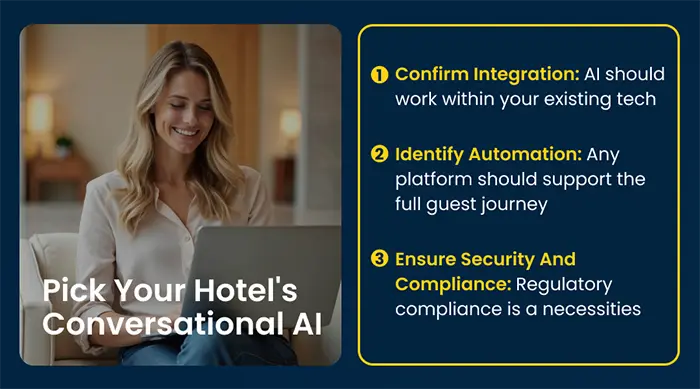
Hospitality-specific solutions are designed to integrate with hotel systems, understand guest workflows and deliver a seamless experience across the entire guest journey. Here’s how to pick the best specialized platform for your hotel:
Evaluate Integration Capabilities
Hospitality-specific AI should work with your existing tech stack to deliver accurate, real-time information across every guest interaction. Deep integrations are a necessity to get the most out of any solution.
In practical terms, solid partnerships streamline workflows. Guests can ask questions about reservations, request late checkout or receive personalized offers without requiring staff to manually update multiple systems. By choosing a platform with robust PMS integration capabilities, you improve operational efficiency and create a more connected guest experience. Look for:
Direct PMS and CRM integrations
Real-time reservation and availability syncing
Automated workflow triggers and updates
Two-way integrations
Scalable options for multiple properties
Assess Guest Journey Automation
The most powerful conversational AI platforms for hotels support the full guest journey, not just one aspect. Look for solutions that enhance engagement before arrival, during the stay and after checkout to create a consistent guest experience.
Your goal is to create capabilities with conversational AI from a single platform. Hospitality-specific tools built around the guest journey do this with built-in knowledge and prioritization of a seamless experience for both guests and staff. Key aspects of the guest journey that should be covered include:
Research and booking support
Pre-arrival and in-stay communication
Virtual concierge assistance throughout the stay
Guest support beyond checkout and reviews
Review Security and Compliance Standards
Security and compliance are essential when handling large amounts of sensitive guest information. That’s why you should expect your AI platform to follow the same strict data protection standards you already adhere to.
Investing in conversational AI with strong hotel cybersecurity protections reduces risk while building guest trust in digital interactions. Important security and compliance considerations include:
PCI-compliant payment processing
Secure guest data encryption
Role-based staff access controls
Compliance with any applicable privacy regulations
Fraud prevention and monitoring tools
Implementing Conversational AI: Hospitality Best Practices
Successfully implementing conversational AI begins with a mindset: treat the system like a staff member who needs goals, training, team introductions and occasional updates. Hotels see the best results when AI implementation aligns with operational workflows, staff processes and the broader guest experience strategy from day one. To get the most out of it, make sure you’re:
1. Defining KPIs Before Deployment
Before implementing conversational AI, hotels should have a clear picture of what success looks like. This will help evaluate performance, justify investment or identify opportunities for improvement later on. Common goals include reducing response times, increasing direct bookings, improving guest satisfaction scores or driving more upsell revenue.
Clear benchmarks also help teams prioritize the right automation workflows during implementation. Common conversational AI KPIs include:
Guest response time reduction
Direct booking conversion rates
Upsell revenue generated
Call abandonment reduction
Guest satisfaction and review scores
2. Designing Conversational Flows Around the Guest Journey
Effective conversational AI should feel natural and connected across every stage of the stay. Instead of treating each guest interaction as a standalone event, hotels should design conversational flows that are coherent throughout the full guest journey, from initial discovery through post-stay follow-up.
A well-designed system like this provides operational consistency. For example, AI recognizes when a guest has requested early check-in, automatically referencing previous conversations and surfacing other relevant recommendations during the stay. This reduces friction for guests while making responses feel more human and context-aware. Best practices for conversational flow design include:
Mapping communication touchpoints across the guest journey
Personalizing responses using guest data
Creating escalation and approval paths for complex requests
Maintaining consistent tone and branding
Automating routine requests while preserving human support
3. Training Staff Members to Work Alongside AI
Conversational AI is the perfect tool for scaling hospitality interactions. It works best when hotel teams understand how to collaborate with it effectively. That’s why training is crucial — it makes adoption easier and operations more efficient.
Front desk agents, managers and guest service teams need to train AI to handle requests automatically, when conversations should escalate and how to adjust workflows when needed. Investing in proper hotel staff training makes sure your teams feel confident using AI-powered tools while keeping service standards high. Staff training should cover:
4. Maintaining Centralized Knowledge and Control of Content
Conversational AI performs best when it pulls from a centralized source of truth. Limiting it to one source prevents guests from receiving conflicting information, and makes it easier to update messaging, manage seasonal changes and scale conversational AI across multiple properties or brands.
To begin, establish clear oversight around property details, policies, amenities and service information to make sure AI responses remain consistent across every channel. Strong content management includes:
Centralized property and amenity information
Standardized brand voice guidelines
Regular review of AI responses and workflows
Version control for policy updates
Cross-department ownership and accountability
5. Monitoring Performance and Optimizing Monthly
Conversational AI is not a set-it-and-forget-it technology. Hotels need to regularly review performance data, guest feedback and operational metrics to identify opportunities for refinement and improvement over time.
Monthly optimization allows hotels to improve response quality, expand automation workflows and identify gaps where guests still require manual support. Approach it like staff meetings and additional training, and you’ll continue to get more use out of conversational AI as your business evolves. Monthly optimization tasks should include:
Reviewing guest satisfaction trends
Identifying unresolved guest requests
Updating conversational workflows
Espandere le opportunità di automazione
Verificare le prestazioni dell'IA e i tassi di escalation
Aumenta la soddisfazione dei clienti con le soluzioni AI di Canary
Gli hotel hanno bisogno di più che semplici strumenti AI generici per offrire esperienze eccezionali agli ospiti su larga scala. Hanno bisogno di un'IA specifica per l'ospitalità, costruita attorno alle realtà delle operazioni alberghiere, alle aspettative degli ospiti e ai flussi di lavoro che i team gestiscono ogni giorno. Canary offre esattamente questo attraverso la sua piattaforma leader del settore di IA per l'ospitalità, che alimenta la comunicazione intelligente con gli ospiti attraverso canali vocali, di messaggistica e webchat.
Costruite specificamente per gli hotel, le soluzioni AI di Canary automatizzano il lavoro ripetitivo, aumentano le opportunità di guadagno e danno al personale più tempo per concentrarsi su interazioni significative con gli ospiti. Dalle conversazioni pre-prenotazione all'engagement post-soggiorno, Canary crea un'esperienza digitale fluida per gli ospiti lungo tutto il percorso.
Con la piattaforma AI per l'ospitalità di Canary, gli hotel possono:
Automatizzare la comunicazione con gli ospiti tramite voce, testo e webchat
Ridurre le chiamate perse e le richieste degli ospiti senza risposta
Offrire supporto istantaneo e multilingue agli ospiti 24 ore su 24, 7 giorni su 7
Personalizzare le offerte di upsell e i consigli per gli ospiti
Ottimizzare le operazioni con le integrazioni PMS e CRM
Migliorare i tempi di risposta e la soddisfazione degli ospiti
Liberare il personale da compiti amministrativi ripetitivi
Scalare l'erogazione di servizi uniformi su tutte le strutture
Prenota una demo oggi stesso e scopri come implementare un'IA conversazionale efficace nel settore dell'ospitalità su larga scala con Canary.